How to Roll a 401(k) or IRA Into a Crypto IRA Without a Tax Hit
To move a 401(k) or an IRA into a crypto IRA without a tax bill, have the money go straight from the old account to the new custodian. From a workplace plan that is a direct rollover; from another IRA it is a trustee-to-trustee transfer. In both cases the IRS says no tax is withheld, and neither counts toward the one-rollover-per-year limit. The method that causes trouble is the 60-day rollover, where the money is paid to you first. Plans must withhold 20% of it, and a missed deadline makes the shortfall taxable.
This guide lays out the three methods side by side, then the steps, the rules that trigger tax, the special case of moving from a gold IRA, and the fees you meet along the way. It follows IRS guidance as read on 9 October 2026 and is general information, not tax or financial advice. It suits someone who has decided a small crypto position in retirement makes sense and wants the move done cleanly. If you have not made that decision yet, read is a crypto IRA a good idea? first: a perfect rollover into the wrong investment is still a mistake.
Three ways to move retirement money, compared
The IRS recognises three ways to move money between retirement accounts, and the differences between them are entirely about who touches the money and when. The safest two never put it in your hands. The table summarises the rules as the IRS states them; the flow diagram below shows where the tax risk sits in each.
| Method | Used for | Tax withheld? | Counts toward one-per-12-months? | Main risk |
|---|---|---|---|---|
| Direct rollover | 401(k), 403(b) or other plan to an IRA | No | No | Low: paperwork errors only |
| Trustee-to-trustee transfer | IRA to IRA, including a gold IRA to a crypto IRA | No | No (not a rollover) | Low: delays between custodians |
| 60-day rollover | Money paid to you, then redeposited | Plan: 20% mandatory. IRA: 10% unless you opt out | Yes, for IRA-to-IRA moves | High: deadline, withholding gap, the one-per-year limit |
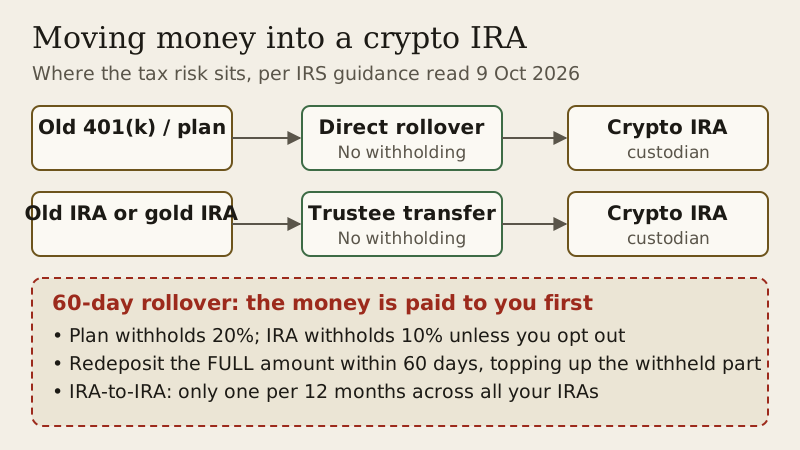
Notice that the crypto part plays no role in these rules. A crypto IRA is a self-directed IRA held by a custodian, so moving money into it follows exactly the same IRS rules as moving money into any other IRA. What changes is what happens after the money arrives: you then place trades, and those trades carry the provider's fees.
Step by step: a direct rollover into a crypto IRA
Most people arrive at a crypto IRA with a 401(k) from a former employer, and the steps below follow that case. The IRS notes you must first meet your plan's conditions for a distribution, "such as termination of employment", so if you still work for the employer, check whether the plan allows in-service distributions before going further.
- Open the receiving IRA first, with the same tax type as the money you are moving: traditional for pre-tax 401(k) money, Roth for designated Roth 401(k) money. The crypto IRA provider or its custodian gives you the account number and the exact payee details.
- Ask your old plan for a direct rollover to that custodian. Use the plan's own form or phone process, and ask for the check, if one is issued, to be made payable to the new custodian for your benefit. The IRS says a check payable to the receiving IRA is not subject to withholding.
- Forward the check or confirm the wire, then watch for the cash to land in the new IRA. Keep copies of every form and statement.
- Only then place any crypto trades, in an amount you have decided on in advance. Rolling money in does not oblige you to buy crypto with all of it; the cash can sit or go into other holdings the custodian offers.
Timelines vary by plan and custodian, so build in slack and do not try to time a market move around a rollover. For IRA-to-IRA moves the steps are similar, but ask the new custodian whether it sends the transfer request to your old IRA's custodian for you; done that way, the money never passes through your hands.
Rules that trigger tax: 60 days, once a year, and withholding
Three IRS rules cause almost every rollover tax problem, and all three only bite when the money is paid to you. The first is the 60-day deadline: you have 60 days from the date you receive a distribution to deposit it in an IRA or plan, though the IRS can waive the deadline in some situations outside your control.
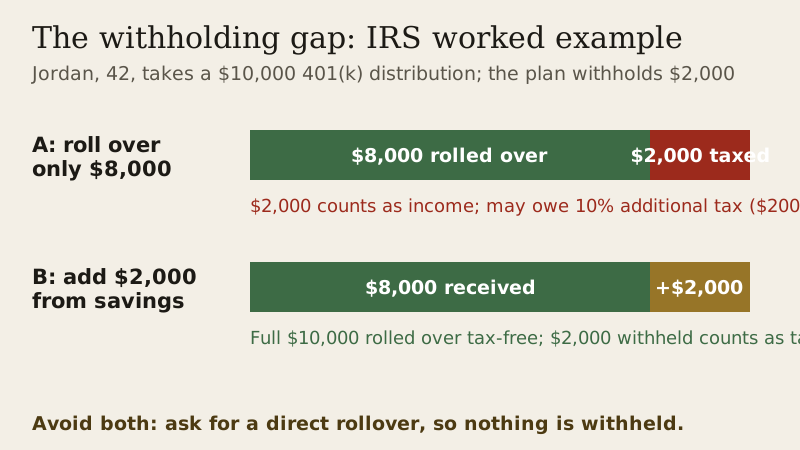
The second is withholding. A plan distribution paid to you is subject to mandatory 20% withholding, even if you intend to roll it over. An IRA distribution paid to you has 10% withheld unless you elect out. To roll over the whole amount you must replace the withheld part from other money; whatever you do not replace is taxable, and before age 59½ it can also owe the 10% additional tax unless an exception applies.
The third is the one-rollover-per-year rule. You can make only one IRA-to-IRA 60-day rollover in any 12-month period, and the IRS adds together all your traditional, Roth, SEP and SIMPLE IRAs for this purpose. A second one is taxable, may owe the 10% additional tax, and if the money is redeposited anyway it can be treated as an excess contribution taxed at 6% a year while it stays. The limit does not apply to trustee-to-trustee transfers, plan-to-IRA rollovers, IRA-to-plan rollovers, plan-to-plan rollovers or Roth conversions.
One more tax trap is about account type, not method. The IRS rollover chart shows pre-tax 401(k) money can go into a Roth IRA, but only with the amount included in income, which makes it a conversion you pay tax on now. Designated Roth 401(k) money can roll into a Roth IRA without that. Under IRS Publication 590-B, each conversion or taxable rollover into a Roth also starts its own five-year clock for the 10% additional tax. Our traditional vs Roth crypto IRA guide covers the trade-off.
Gold IRA to crypto IRA
Moving from a precious-metals IRA to a crypto IRA is an IRA-to-IRA move, so use a trustee-to-trustee transfer: per IRS Publication 590-A, a direct transfer between trustees is not a rollover, is tax-free and is not limited by the one-per-year rule. The practical question is what moves. Depending on what each custodian accepts, the metal may have to be sold to cash before the transfer, so ask both custodians whether they can move metal in kind or only cash, and what each charges to sell, ship or close.
If you want to keep some metal alongside crypto, one provider offers both in the same account. iTrustCapital displays physical gold at $125 an ounce over spot and silver at $6 an ounce over spot, with a 1% fee per crypto transaction and no startup or exit fees, as displayed on 9 October 2026 (partner link; we may be paid if you open an account). Whether it accepts an in-kind metals transfer is a question to ask before you start.
Fees at each step
A rollover is free under tax law, but the institutions on either side can still charge. Expect up to four kinds of cost: a closing or transfer-out fee at the old plan or IRA, any setup or account fee at the new custodian, a trade fee when you buy crypto, and the ongoing account or custody fee while you hold it. On published schedules as of 9 October 2026, iTrustCapital lists no startup or exit fees and a 1% fee per crypto transaction; Bitcoin IRA lists no setup or deposit fee, a 2% IRA trade fee and custody charged at 0.08% of assets monthly, subject to a $20 floor each month; Fidelity's Crypto IRA has no fee to open or maintain and a 1% trading fee, but is funded from a linked Fidelity brokerage IRA, so the rollover lands there first.
Exit fees are the easiest to miss. As one published example, Alto's pricing page shows a $50 account-closure fee. Ask your old plan or IRA custodian for its fee schedule before you file the request, and check whether it charges per account or per asset sold. BitIRA, another provider, sets up accounts with Equity Trust and does not publish its transaction-based fee on its homepage; ask BitIRA for the full schedule in writing if you are comparing it (partner link). Our crypto IRA fees explained guide shows how the ongoing fees compound once the money is in.
Risks and what can go wrong
Crypto is highly volatile and you can lose some or all of the money you roll over. Never move your whole retirement balance into crypto. This is general information, not tax, financial or retirement advice; confirm the steps with your plan administrator and a tax professional.
Beyond price, the risks in a rollover are process risks. A check made payable to you instead of the new custodian turns a direct rollover into a 60-day rollover with 20% withheld. A second IRA-to-IRA rollover inside 12 months is taxable. Putting pre-tax money into a Roth by accident creates a tax bill. Per the IRS rollovers page, leaving a balance between $1,000 and $5,000 behind at an old employer can see the plan move it to an IRA in your name if you make no election, and $1,000 or less may be paid out to you, in most cases with 20% withheld. And high-pressure sellers are a known hazard: anyone urging you to roll your entire 401(k) into crypto, or to act before reading the fee schedule, is showing you one of the crypto IRA red flags.
Edge cases
If you are 73 or older, the required minimum distribution for the year cannot be rolled over, per the IRS, so take it before moving the rest. Hardship distributions, loans treated as distributions and a series of substantially equal payments are also not eligible to be rolled over. If your plan pays out $200 or more as an eligible rollover distribution, it must tell you about your rollover rights and facilitate a direct transfer. And a new employer's plan is not required to accept rollovers, so if you are thinking of consolidating there instead, ask first. If you are still deciding which provider to roll into, compare them fee-first in our best crypto IRAs roundup, which keeps the low-fee spot-ETF option that pays us nothing in the comparison.
Crypto IRA rollover: common questions
Can I roll my 401(k) into a bitcoin IRA?
Is a crypto IRA rollover taxable?
How do I move a gold IRA into a crypto IRA?
What is the 60-day rollover rule?
Which coins can I hold after a 401(k) rollover?
If you are weighing this up, see the best crypto IRAs, compared on fees first, and the honest counterweight — is a crypto IRA even a good idea?. General information, not financial, tax or retirement advice — crypto is volatile, fees compound, and money is locked until 59½; consult a fiduciary advisor about your own situation.