Bitcoin in Your 401(k) (2026): What the New Rules Allow
For most workers, the answer is still no: you can only buy bitcoin inside a 401(k) if your plan offers a way to do it, and the rules that changed in 2025 did not change that. What did change is the federal tone. The Department of Labor withdrew its 2022 "extreme care" warning on 28 May 2025, and Executive Order 14330 (7 August 2025) told the Labor Secretary to revisit 401(k) guidance on alternative assets. As of 9 October 2026, the rule that order produced is still only a proposal.
So the realistic routes to bitcoin from retirement money are the same four as before, in rough order of cost: a crypto option your employer has added to the plan menu (uncommon), a spot bitcoin ETF bought through a brokerage window (if your plan has one), a direct rollover of an old 401(k) into an IRA once you have left that employer, and a self-directed solo 401(k) if you work for yourself. This guide walks through each, with the 2026 limits and the fees that decide whether any of it is worth doing. It is US-focused general information, checked 9 October 2026, and it is not financial, tax or retirement advice.
Who this is for: someone with a workplace plan who keeps hearing that "bitcoin is allowed in 401(k)s now" and wants to know what that means for their own account. Who should skip it: anyone without an emergency fund, anyone carrying high-interest debt, and anyone who would need this money within five years. A volatile asset can fall by half or more and stay down for years, and retirement money is the money you can least afford to see do that.
What changed in 2025 and 2026, in order
Four official documents set the current position, and reading them in sequence clears up most of the confusion in news coverage. On 10 March 2022 the Department of Labor (DOL) issued Compliance Assistance Release 2022-01, which told plan fiduciaries to use "extreme care" before adding cryptocurrency to a 401(k) menu. That release is the source of most of the caution you will still see quoted online.
On 28 May 2025 the DOL issued Compliance Assistance Release 2025-01, which rescinded the 2022 release in full. In its own words, the department returned to "neither endorsing, nor disapproving of" fiduciaries who decide crypto belongs on their menu. Note what that does and does not do: it removes a warning, but it does not instruct any employer to add anything.
On 7 August 2025 the President signed Executive Order 14330, "Democratizing Access to Alternative Assets for 401(k) Investors", published at 90 FR 38921 on 12 August 2025. Its definition of alternative assets includes "holdings in actively managed investment vehicles that are investing in digital assets", and it gave the Labor Secretary 180 days to re-examine fiduciary guidance and propose rules, possibly with safe harbors. It is aimed at funds that hold digital assets among other things, not at loose bitcoin sitting in your account.
On 31 March 2026 the DOL published a proposed rule, "Fiduciary Duties in Selecting Designated Investment Alternatives" (91 FR 16088), which offers a process-based safe harbor for how fiduciaries pick menu options. The proposal is asset-neutral: it says it does not require or restrict any particular type of investment. Comments closed on 1 June 2026, and a search of the Federal Register on 9 October 2026 found no final rule.
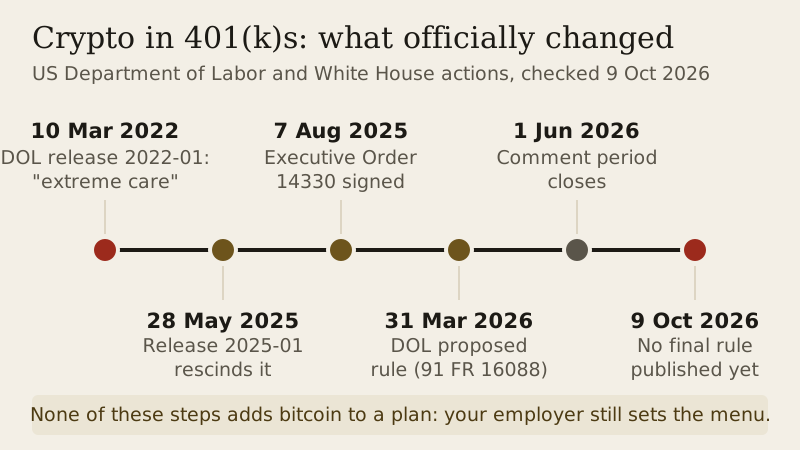
The practical reading: the policy door is more open than it was in 2024, but nothing in federal law now puts bitcoin into your plan automatically. Whether you can buy it still depends on what your employer and its recordkeeper choose to offer, and on the investment options in your own plan documents.
Can you buy Bitcoin in a normal 401(k)?
Only through an option your plan already includes. A 401(k) is a menu chosen by the employer as plan sponsor, and you can only buy what is on that menu or, where the plan has one, what its brokerage window allows. The Government Accountability Office noted in December 2024 that "since 2022, some investment firms have offered options for participants to invest in crypto assets", but its report (GAO-25-106161) also found that the Department of Labor lacks comprehensive data to identify which 401(k) plans give participants that access, and its title points to low participant use.
To find out what your plan allows, log in to your plan website and open the full investment list, or read the summary plan description and the fee disclosure your plan must send you. If neither mentions a digital-asset option or a self-directed brokerage account, ask the plan administrator in writing. Ask three specific questions: is there a crypto option on the core menu, is there a brokerage window, and if so, does the window allow exchange-traded funds?
Treat any answer as plan-specific. Two employers using the same recordkeeper can make different choices, and a plan can add or remove an option at any time with notice. Even where a crypto option exists, plans commonly cap how much of your balance or contributions can go into it; check your plan's own terms rather than relying on a figure you read elsewhere.
Four routes from a 401(k) to bitcoin exposure
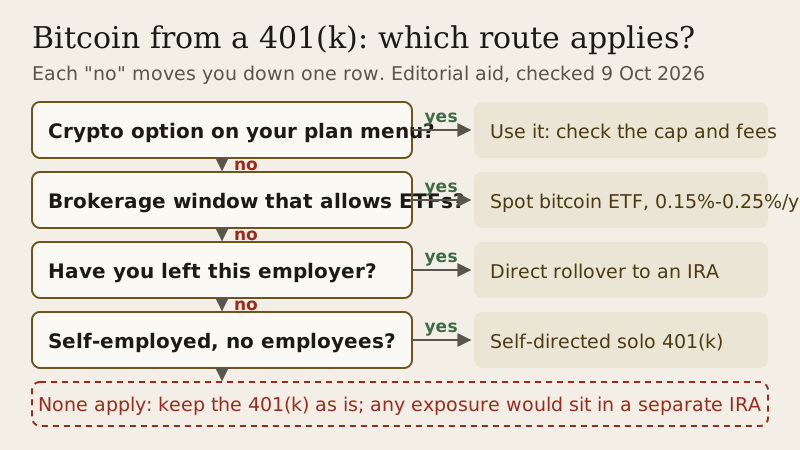
Every path below exists today; which ones apply depends on your plan and your job status. The flow chart sorts them by the question that decides each one. A useful rule of thumb is that the routes nearer the top keep your money inside the plan's protections and low fees, while the routes nearer the bottom add an account, a provider and a fee schedule.
1. A crypto option on your plan menu
If your employer has added one, this is the most direct route, because it sits inside the plan you already use and your contributions, match and payroll deductions carry on unchanged. Read the option's fee disclosure before you elect it: crypto options can carry trading, custody or account fees that a target-date fund does not, and the caps employers set exist because a single volatile asset can dominate a small balance. After the 2025 rescission, the DOL is officially neutral on whether a fiduciary offers such an option. Neutral is not an endorsement.
2. A spot bitcoin ETF through a brokerage window
Some larger plans include a self-directed brokerage window that lets you buy funds outside the core menu. Where that window allows ETFs, you may be able to buy a spot bitcoin ETF with existing 401(k) money. As of 9 October 2026 the main US spot bitcoin ETFs charged annual sponsor fees between 0.15% (Grayscale Bitcoin Mini Trust, ticker BTC) and 0.25% (iShares IBIT and Fidelity FBTC), per their issuers. The outlier is Grayscale's original GBTC at 1.5% a year, so check the ticker before you buy. GAO noted that the DOL has generally not required fiduciaries to monitor everything available through a brokerage window, which means you are the one watching that position.
3. Roll an old 401(k) into an IRA
Once you have left an employer, you can usually move that plan's balance to an IRA. The IRS notes you must first meet your plan's conditions for a distribution, "such as termination of employment", so this route rarely works for the plan you are still contributing to. Done as a direct rollover, nothing is withheld; if the plan pays you instead, it must withhold 20% and you have 60 days to redeposit the full amount, making up the withheld fifth from other money. Once the funds are in an IRA, you can buy a spot ETF at a brokerage or open a dedicated crypto IRA. Our explainer on how a self-directed IRA holds crypto covers the account itself.
If you choose a dedicated crypto IRA, compare fees first. iTrustCapital displays a 1% fee per crypto transaction and no monthly account fee for its standard account (as displayed on 9 October 2026; it notes that additional asset pricing fees may apply). BitIRA sets up accounts with Equity Trust as custodian and charges a fee based on transaction value that it does not publish on its homepage, so ask for the schedule in writing. Both links are partner links: we may be paid if you open an account, and that does not change the comparison. A spot ETF in an ordinary brokerage IRA pays us nothing and is often the cheaper choice.
4. A self-directed solo 401(k)
If you have self-employment income and no employees, you can set up your own solo 401(k), and a self-directed version can be built to hold alternative assets. The 2026 employee deferral limit is $24,500, with an $8,000 catch-up from age 50 and $11,250 for ages 60 to 63, per IRS release IR-2025-111. Those headroom numbers are why the route appeals, but self-directed plans come with prohibited-transaction rules and reporting duties, and errors can be expensive. Get professional help before setting one up.
What each route costs (dated)
Fees are the one thing in this decision you can control, and they compound against you every year. The table puts each route's published charges side by side as displayed on 9 October 2026. It shows fee types rather than a single all-in figure, because the right comparison depends on how often you buy and sell and how long you hold.
| Route | Where it is held | Published cost | Main catch |
|---|---|---|---|
| Crypto option on plan menu | Inside your 401(k) | Set by your plan; read its fee disclosure | Few plans offer one; caps common |
| Spot bitcoin ETF via brokerage window | Inside your 401(k) | 0.15%-0.25%/yr for BTC, BITB, ARKB, IBIT, FBTC; GBTC 1.5%/yr | Needs a window that allows ETFs; fund shares, not coins |
| Rollover, then spot ETF in a brokerage IRA | IRA at a broker | Same ETF sponsor fees; check your broker's commission | Only after you leave the employer |
| Rollover, then Fidelity Crypto IRA | IRA, custodied by Fidelity Digital Assets | 1% per trade; $0 to open, maintain or custody | BTC, ETH, LTC, SOL only; not in CA or OR |
| Rollover, then iTrustCapital | Crypto IRA | 1% per crypto transaction; $0 monthly for standard account | Custodial; you never hold keys |
| Rollover, then BitIRA | Crypto IRA (Equity Trust) | Transaction-value fee, not published on homepage | Get the fee schedule in writing |
| Self-directed solo 401(k) | Your own plan | Setup and admin costs vary by provider | Self-employed only; compliance burden |
Two cost points tend to be missed. First, a 1% trade fee is levied on purchase and again on sale, so a buy followed by a sell costs about 2% of the amount traded before any spread. Second, an annual fund fee is charged on the whole balance every year, so its cost grows if bitcoin rises. Neither is better in every case. Our crypto IRA fees explained guide shows how the two structures compound over decades.
Fiduciary questions to ask before you move a dollar
A plan fiduciary has to act prudently when choosing the menu, which is why the DOL's guidance matters. Once you leave the menu, through a brokerage window or a rollover, much of that protection moves to you. Before you act, it is worth putting the same questions a careful fiduciary would ask to yourself.
- Am I capturing the full employer match first? A match is a return on your contribution that no investment choice reliably beats.
- Do I have an emergency fund and no high-interest debt? If not, those come before any speculative position.
- What share of my total retirement savings would this be? Many cautious investors keep a volatile asset to a small slice or none at all.
- What will I pay each year, all in, and what does it cost to sell?
- Who holds the assets, and what happens to them if that company fails?
If those answers leave you unsure, that is a reasonable signal to wait. Nothing about the 2025 to 2026 changes creates a deadline, and the proposed DOL rule may still change before it is final. Our piece on how much crypto belongs in retirement goes deeper on sizing.
Risks and what can go wrong
Crypto is highly volatile and you can lose some or all of the money you put in. Retirement accounts carry penalties for early access: withdrawals before age 59½ generally owe a 10% additional tax unless an exception applies, on top of any income tax. Nothing here is financial, tax or retirement advice.
Beyond price risk, three failure modes are specific to retirement money. A rollover done wrong can turn a tax-free move into a taxable distribution: missing the 60-day window, or failing to replace the 20% a plan withheld, makes the shortfall taxable and possibly subject to the 10% additional tax. Custodial risk is real, because a crypto IRA or crypto plan option is held by a company, not by you, and FDIC and SIPC protections do not cover crypto itself. And scams follow headlines: the FBI's IC3 received 61,559 crypto investment fraud complaints in 2025 with $7.228 billion in reported losses, and people aged 60 and over reported $2.76 billion of that. Anyone pressing you to move your whole 401(k) into crypto quickly is showing you a red flag.
Edge cases
Roth money keeps its character. A designated Roth 401(k) account can roll into a Roth IRA, and the IRS rollover chart shows pre-tax 401(k) money moving into a Roth IRA as a taxable conversion that "must include in income". If you are still employed, ask whether your plan permits in-service distributions; most do not, so the rollover route usually waits until you leave. Small balances follow their own rule: per the IRS rollovers page, if you leave a job with $1,000 to $5,000 in the plan and make no election, the administrator may move it to an IRA in your name, and $1,000 or less may simply be paid out to you, in most cases with 20% withheld; your plan documents set the exact thresholds. And if you are 73 or older, required minimum distributions from a traditional 401(k) or IRA continue regardless of what the account holds, so a volatile asset can force a sale at a bad moment.
If after all that a small position via an IRA still fits, compare providers fee-first in our roundup of the best crypto IRAs, where the spot-ETF option that pays us nothing stays in the comparison.
Bitcoin 401(k): common questions
Can I buy bitcoin in my 401(k)?
Did Trump's executive order put crypto in 401(k)s?
Can I roll my 401(k) into a bitcoin IRA?
How much can I put into a 401(k) in 2026?
Is a bitcoin 401(k) a good idea?
If you are weighing this up, see the best crypto IRAs, compared on fees first, and the honest counterweight — is a crypto IRA even a good idea?. General information, not financial, tax or retirement advice — crypto is volatile, fees compound, and money is locked until 59½; consult a fiduciary advisor about your own situation.