Bitcoin IRA Review vs iTrustCapital (2026): Fees, Custody, Coins
Bitcoin IRA is a real, operating crypto IRA company with a published fee schedule, but on those published fees it is far more expensive to hold than iTrustCapital. As displayed on 9 October 2026, Bitcoin IRA charges 2% per IRA trade in either direction and custody at 0.08% monthly, with a $20 monthly minimum; iTrustCapital charges 1% per crypto transaction and no monthly account fee. On a $25,000 deposit held ten years at a flat price, that works out to about $2,900 at Bitcoin IRA against $250 at iTrustCapital before selling.
Bitcoin IRA can still suit someone who wants its longer coin list or its particular custody set-up and accepts the cost. Most savers comparing the two on price will find iTrustCapital cheaper, and a spot bitcoin ETF in an ordinary IRA cheaper still for bitcoin-only exposure. This review is general information, checked 9 October 2026; it is not financial advice, and it uses no hands-on testing, only the companies' own published terms.
One naming trap first. Bitcoin IRA (bitcoinira.com) and BitIRA (bitira.com) are different companies with different custodians and addresses. Reviews and search results mix them up constantly, so check which one you are reading about before you rely on anything, including complaints.
Who the two companies are
Bitcoin IRA describes itself as a trade name of Alternative IRA Services, LLC, founded in 2016 by Camilo Concha, Johannes Haze and Chris Kline; it calls itself the first company of its kind, which is its own claim. Its about page names Digital Trust LLC, a Nevada-chartered trust company, as custodian, with BitGo multi-signature wallets, and says customers do not choose their custody partner. It lists more than 100 cryptocurrencies.
iTrustCapital describes itself as a software platform, not an exchange, custodian, trust company, broker-dealer or investment adviser. Its help center (updated 14 February 2026) names Fortis Bank as its current qualified custodian and lists Coinbase Custody, Fidelity Digital Assets and Fireblocks as institutional storage providers, using multi-party computation and offline cold storage. It says client assets are held for the benefit of clients one-to-one, off its balance sheet. It also offers physical gold and silver in the same account.
Bitcoin IRA vs iTrustCapital: fees side by side (dated)
Both companies publish their core fees, which makes a straight comparison possible. The table uses only what each displayed on 9 October 2026. Both say fees can change, Bitcoin IRA "with written notice" and iTrustCapital noting that "additional asset pricing fees may apply", so treat this as a snapshot and confirm on each fee page before you open an account.
| Bitcoin IRA (bitcoinira.com) | iTrustCapital | |
|---|---|---|
| Setup or deposit fee | $0 | $0 (no startup or exit fees) |
| Crypto trade fee (IRA) | 2% per buy or sell | 1% per transaction |
| Account or custody fee | 0.08% of assets per month, $20/month minimum | $0 monthly or annual |
| Qualified custodian | Digital Trust LLC (Nevada trust company) | Fortis Bank |
| Storage and security | BitGo multi-signature wallets | Coinbase Custody, Fidelity Digital Assets, Fireblocks; MPC, cold storage |
| Coins | 100+ cryptocurrencies | Crypto plus physical gold and silver |
| Moving crypto in | Not stated on fee page | In-kind transfer from another crypto IRA for coins it holds; new contributions in USD only |
| Minimum to open | Not shown on fee page | Not confirmed for IRAs; check current |
| Pays this site | No | Yes (partner link) |
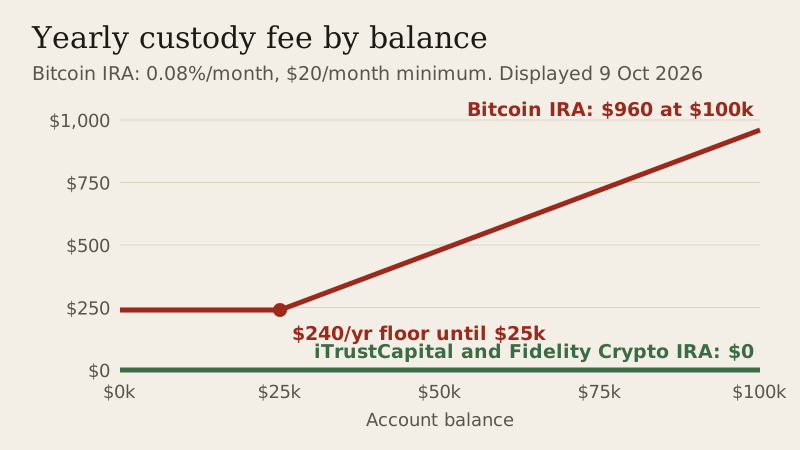
The structural difference is the custody fee. iTrustCapital's cost is concentrated at the moment you trade; Bitcoin IRA charges every month you hold. That makes Bitcoin IRA relatively worse the longer you hold and the smaller your balance, because of the $20 floor. At 0.08% a month, the floor stops binding only once your balance passes $25,000, and above that the fee works out to 0.96% a year on the whole balance.
If those numbers point you to the cheaper platform, iTrustCapital is our partner, and we may be paid if you open an account. That does not change the arithmetic in this section, and the cheaper ETF route below pays us nothing.
Affiliate link, marked sponsored/nofollow. We may earn a commission at no cost to you — it never changes a ranking. Check availability, fees and eligibility in your own country first; crypto is volatile and you can lose money.
10-year cost at $25,000 (computed)
To compare like with like, we modelled a single $25,000 deposit, bought once on day one and held for ten years at an unchanging price. The flat price is a device to isolate fees, not a prediction. For context, we added two routes that pay us nothing: Fidelity's Crypto IRA (1% trading fee, no custody fee, as displayed on 9 October 2026) and a spot bitcoin ETF at a 0.25% annual sponsor fee in an ordinary IRA.
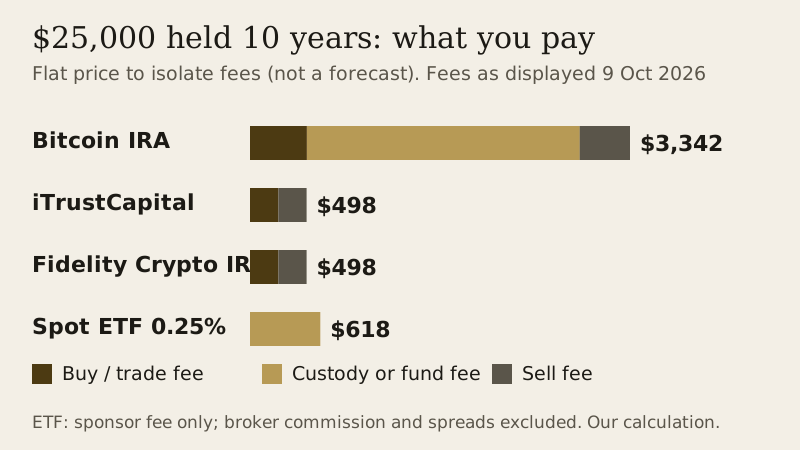
On these assumptions, Bitcoin IRA costs about $3,342 over ten years including the sale, against $498 at iTrustCapital and the same at Fidelity's Crypto IRA, and about $618 for a 0.25% ETF. Most of Bitcoin IRA's gap is custody: $2,400 of the total, because a $24,500 balance sits below the $25,000 point where the $20 floor stops applying. If bitcoin rose, Bitcoin IRA's percentage custody fee and the ETF's sponsor fee would both rise in dollars; the 1% routes' purchase fee would not.
Custody and insurance claims, examined
Both companies use a qualified custodian and institutional storage, which is the structure a crypto IRA should have; neither lets you hold your own keys inside the IRA. The differences are in who the custodian is and how insurance is described. Bitcoin IRA's about page states that it is not FDIC-insured and not SIPC-insured, and that "insurance may vary based on asset chosen and custody solution available." iTrustCapital's help center says its storage providers carry commercial crime insurance but do not disclose the amounts, and adds that no crypto insurance policy covers everything.
Read every insurance claim the same way: at most it covers theft or hacking at the custodian, never a fall in price, which is the bigger risk for retirement money. Neither FDIC nor SIPC protection applies to crypto. If a company stresses insurance in its sales pitch, ask for the insurer, the policy limit and whether the cover is per client or shared across all clients. Our guide to crypto IRA security and custody has a fuller checklist.
Failure planning is worth a question too. iTrustCapital says that if it or Fortis Bank wound down, clients would keep ownership of their assets and would move them to another qualified custodian, and that client assets are never mixed with operating funds. Bitcoin IRA's pages we read did not set out a wind-down process, so ask for it in writing.
Coins and features
Coin count is where Bitcoin IRA leads: it lists more than 100 cryptocurrencies, which matters only if you specifically want smaller tokens inside a retirement account. For retirement money, a long coin list is more temptation than benefit; smaller tokens tend to be more volatile and less liquid than bitcoin and ether. iTrustCapital's differentiator is the gold and silver option in the same account, at $125 an ounce over spot for gold and $6 an ounce over spot for silver as displayed on 9 October 2026, which some people use to keep metals and crypto in one place.
Bitcoin IRA also offers a non-IRA "Freedom Account" at 1% per trade with no monthly custody fee. That is a taxable account, not a retirement one, so it is not a way round the IRA fees.
Track record, complaints and what we could not verify
We did not open accounts, test customer service or verify complaint volumes, and we will not quote star ratings we cannot check. When you research complaints yourself, search by the exact company name and website, because BitIRA, Bitcoin IRA and similarly named firms are often confused in review sites and forums. Check which custodian a complaint concerns, too, since problems with transfers often sit with the custodian rather than the platform.
Legitimacy and suitability are different questions. A company can be properly structured and still be too expensive for your balance. Use the fee table above, ask both firms for their full schedule including spreads and any minimums in writing, and compare them with the ETF route before deciding. Our crypto IRA fees explained guide shows how each fee type compounds, and crypto IRA red flags lists warning signs in sales calls.
Which one fits, and switching if you already have an account
Bitcoin IRA fits a narrow case: you specifically want coins beyond the majors inside an IRA, your balance is well above $25,000 so the custody floor matters less, and you have compared its all-in yearly cost with the alternatives in writing. iTrustCapital fits someone who trades rarely, wants no monthly fee and is content with its coin list, or who wants metals in the same account. A spot bitcoin ETF in an ordinary brokerage IRA fits anyone who only wants bitcoin price exposure at the lowest running cost and does not need coins in their own name. Holding none at all fits anyone for whom a fall of half the position would change their retirement plans.
If you already hold a Bitcoin IRA account and the fee maths now looks wrong, moving is possible, but do it as a trustee-to-trustee transfer. IRS Publication 590-A says a direct transfer between IRA trustees is not a rollover, so it is tax-free and not limited by the one-rollover-per-year rule. Ask both companies first whether the coins can move in kind or must be sold to cash: a sale would cost Bitcoin IRA's 2% sell fee, and buying again at the new provider would cost its trade fee. Never take the money out yourself to move it, because an IRA distribution paid to you starts a 60-day clock and can have 10% withheld. Our guide to how a self-directed IRA holds crypto explains the custodian's role in that move.
Risks and what can go wrong
Crypto is highly volatile and you can lose some or all of what you invest. A crypto IRA is custodial, fees compound every year, and money withdrawn before 59½ generally owes a 10% additional tax unless an exception applies. This review is not financial advice.
Price risk is the large one: bitcoin has gone through repeated steep falls, and a retirement saver near the end of their working life has the least time to wait for a recovery. Then come fee drift, since both companies say fees can change; custodian or platform failure, where recovery depends on asset segregation; and the operational risk of a rollover done wrong, covered in our explainer on what a crypto IRA is. If you hold any crypto in retirement, keep it to a size you could see fall sharply without changing your plans.
Bitcoin IRA review: common questions
Is Bitcoin IRA legit?
What are Bitcoin IRA's fees?
Bitcoin IRA vs iTrustCapital: which is cheaper?
Is Bitcoin IRA the same as BitIRA?
Does Bitcoin IRA insure my crypto?
If you are weighing this up, see the best crypto IRAs, compared on fees first, and the honest counterweight — is a crypto IRA even a good idea?. General information, not financial, tax or retirement advice — crypto is volatile, fees compound, and money is locked until 59½; consult a fiduciary advisor about your own situation.