Can You Buy Bitcoin in a Roth IRA? Three Routes Compared (2026)
Yes. You can hold bitcoin exposure in a Roth IRA in three ways: buy a spot bitcoin ETF in an ordinary Roth at a brokerage, open a Roth with a dedicated crypto IRA platform that buys the coins for you, or use Fidelity's Crypto IRA, which offers a Roth version. They differ in what you actually own, who holds it and, above all, what you pay. On our dated fee model, ten years of $7,500 contributions cost anywhere from about $616 to $5,537 in fees, before you sell anything.
This guide compares the three routes side by side with fees as displayed on 9 October 2026, then covers the 2026 contribution limits, the five-year rule and what can go wrong. It is US-focused general information, not financial or tax advice. Who it suits: someone who already funds a Roth, has an emergency fund and no high-interest debt, and wants to know whether a small crypto slice fits inside it. Who should skip it: anyone who might need this money within five years, or who would be tempted to put most of a Roth into one volatile asset.
Why the Roth wrapper matters for a volatile asset
A Roth IRA is funded with money you have already paid tax on; the IRS says plainly that "you cannot deduct contributions to a Roth IRA." In return, qualified distributions come out tax-free, including any growth. That trade is why people ask about bitcoin in a Roth specifically: if a small position rose sharply, the gain would never be taxed. The same logic works in reverse. If the position falls, you have used scarce Roth contribution room on a loss, and you cannot deduct that loss the way you might in a taxable account.
Trades inside any IRA do not create a taxable event at the time, so moving between bitcoin and a cash fund inside the Roth does not trigger capital gains tax. Outside an IRA, digital assets count as property for US tax purposes, per the IRS, which makes a sale or swap a reportable event. Our crypto IRA tax rules guide covers that difference in more detail, and traditional vs Roth crypto IRA covers which wrapper fits whom.
Route 1: a spot bitcoin ETF in a regular Roth
The cheapest and simplest route for most people is a spot bitcoin ETF bought inside a Roth IRA at an ordinary brokerage. You own fund shares, not coins, and the fund's sponsor holds the bitcoin with a custodian. As of 9 October 2026, the issuers listed annual sponsor fees of 0.15% for Grayscale Bitcoin Mini Trust (BTC), 0.20% for Bitwise (BITB), 0.21% for ARK 21Shares (ARKB) and 0.25% for both iShares (IBIT) and Fidelity (FBTC). Grayscale's older GBTC charges 1.5% a year, so it does not belong in that low-cost group.
What you give up: you cannot withdraw coins to your own wallet, you only get the asset the fund holds, and the fee is charged every year on the whole balance, so its dollar cost rises if bitcoin does. What you gain: no separate account, no crypto platform, and the same brokerage protections and statements as the rest of your Roth. A spot ETF route pays us nothing, and we include it because it is often the honest answer.
Route 2: a crypto IRA platform
Dedicated crypto IRA companies open a self-directed IRA with a custodian and buy actual coins inside it. You get a wider coin list and, with some, the ability to trade around the clock, but you also add a provider and a fee schedule. Fees vary far more between these platforms than between ETFs, which is why we model them one by one. If you want the structure first, our explainer on how a self-directed IRA holds crypto walks through the custodian's role.
iTrustCapital
iTrustCapital displays a 1% fee per cryptocurrency transaction, no monthly or annual account fee and no startup or exit fees, as displayed on 9 October 2026; it notes that additional asset pricing fees may apply and that all fees are subject to change. It also offers physical gold and silver in the same account. We could not confirm a current minimum to open an IRA, so check that on its site. Partner link: we may be paid if you open an account.
Affiliate link, marked sponsored/nofollow. We may earn a commission at no cost to you — it never changes a ranking. Check availability, fees and eligibility in your own country first; crypto is volatile and you can lose money.
Bitcoin IRA and BitIRA (two different companies)
Bitcoin IRA (bitcoinira.com), a trade name of Alternative IRA Services, LLC, displays a 2% trading fee on each IRA buy or sell and a custody fee of 0.08% of asset value per month with a $20 monthly minimum, and no setup or deposit fee, as displayed on 9 October 2026. Its custodian is Digital Trust LLC. That $20 floor matters on a new Roth: until the balance passes $25,000, you pay $240 a year in custody whatever you hold. BitIRA (bitira.com) is a separate firm whose accounts are set up with Equity Trust; it charges a fee based on transaction value that it does not publish on its homepage, so ask for the full schedule in writing before you sign. We may be paid if you open an account through our BitIRA link; Bitcoin IRA pays us nothing.
Affiliate link, marked sponsored/nofollow. We may earn a commission at no cost to you — it never changes a ranking. Check availability, fees and eligibility in your own country first; crypto is volatile and you can lose money.
Route 3: Fidelity Crypto IRA
Fidelity's Crypto IRA is a middle path: you buy real coins, but inside the Fidelity ecosystem. As displayed on 9 October 2026, it is available as a Roth, traditional or rollover IRA; holds bitcoin, ether, litecoin and solana subject to state availability; and charges no fee to open, maintain or custody the account. Fidelity Digital Assets charges a 1% trading fee on buys and sells. It is funded in dollars from a linked Fidelity brokerage IRA, does not accept or send crypto transfers, and is not available in California or Oregon. It pays us nothing.
Fees compared over 10 years (computed)
To isolate fees, our model assumes you contribute the 2026 maximum of $7,500 at the start of each year for ten years and that the price never moves. That flat price is not a forecast; it simply strips out returns so only fees remain. ETF fees are charged annually on the balance; platform trade fees are charged on each purchase; Bitcoin IRA's custody fee is charged monthly at the greater of 0.08% or $20. Selling later would add another trade fee on the trade-fee routes.
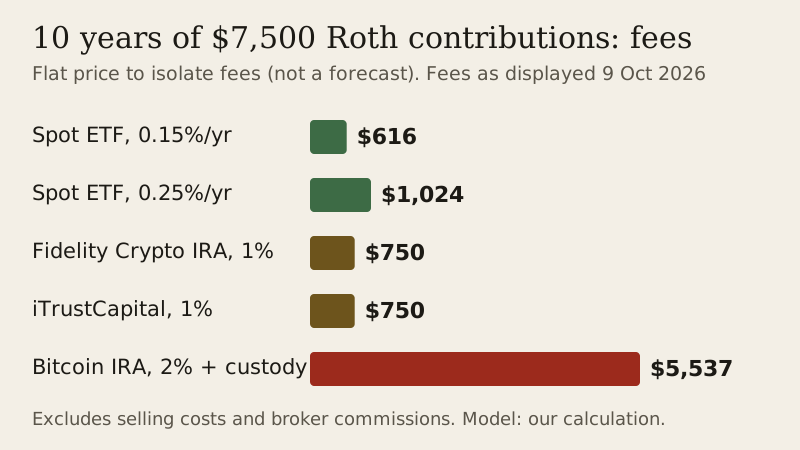
The result is stark at the expensive end and close at the cheap end. Both 1% platforms cost $750 over the decade on these assumptions, a low-fee ETF about $616 and a 0.25% ETF about $1,024, while Bitcoin IRA comes to about $5,537, more than seven times the 1% routes. Two caveats keep the cheap end honest. An ETF's fee grows with the balance, so if bitcoin rose substantially the ETF's dollar cost would rise too, while a 1% trade fee is fixed at purchase. And a 1% route charges again when you sell, which the ETF does not, apart from any commission and the fund's trading spread.
| Spot bitcoin ETF in a brokerage Roth | Crypto IRA platform | Fidelity Crypto IRA (Roth) | |
|---|---|---|---|
| What you own | Fund shares | Coins held by the platform's custodian | Coins held by Fidelity Digital Assets |
| Coins available | Bitcoin only (one asset per fund) | Wide lists; Bitcoin IRA says 100+ | BTC, ETH, LTC, SOL |
| Ongoing fee | 0.15%-0.25%/yr (GBTC 1.5%) | iTrustCapital $0 monthly; Bitcoin IRA 0.08%/mo, $20 minimum | $0 to open, maintain or custody |
| Trade fee | Broker commission, if any | iTrustCapital 1%; Bitcoin IRA 2%; BitIRA unpublished | 1% per buy or sell |
| Move coins out | No | Varies by platform | No crypto transfers in or out |
| Pays us | Nothing | iTrustCapital, BitIRA: yes. Bitcoin IRA: nothing | Nothing |
Contribution limits and the five-year rule
For 2026 the IRA contribution limit is $7,500 ($8,600 from age 50), and it is shared across all your traditional and Roth IRAs combined, per the IRS (page reviewed 23 September 2026). Whether you can contribute directly to a Roth depends on income: for 2026 the allowance phases out between $153,000 and $168,000 of modified adjusted gross income for single filers and between $242,000 and $252,000 for married couples filing jointly. Crypto changes none of these numbers.
The five-year rule decides when growth comes out tax-free. IRS Publication 590-B defines a qualified distribution as one made after the five-year period beginning with the first tax year for which you contributed to any Roth IRA, and made at or after age 59½, because of disability, to a beneficiary after death, or for a first home up to a $10,000 lifetime limit. Withdrawals that are not qualified follow a fixed order, shown below: your regular contributions come out first, then conversion and rollover amounts, oldest first, and earnings last. Each conversion also has its own five-year clock for the 10% additional tax.
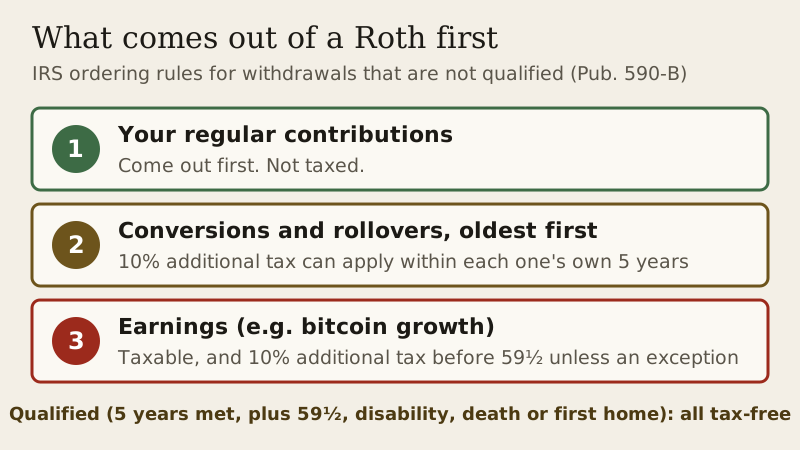
Two practical consequences follow for a crypto slice. Because contributions come out first, a Roth gives you more flexibility than a traditional IRA if you ever had to unwind, though that is a safety valve, not a plan. And because Roth IRAs have no required minimum distributions during the original owner's lifetime, you are never forced to sell a depressed position to meet an RMD, unlike a traditional IRA from age 73.
Risks and what can go wrong
Bitcoin is highly volatile and you can lose some or all of what you put in. Losses inside a Roth cannot be deducted, and the contribution room you used does not come back. This is general information, not financial, tax or retirement advice.
The risks people underestimate are structural, not just price swings. A crypto IRA platform is a custodial service: you never hold the keys, and if the platform or its custodian failed, recovery would depend on how the assets were segregated. Bitcoin IRA's own page states it is not FDIC- or SIPC-insured, and SIPC does not cover crypto anyway. Fee schedules can change with notice. Platforms differ on which coins they list and can delist. And fraud follows retirement money: the FBI's 2025 IC3 report counted $2.76 billion in reported crypto investment fraud losses among people aged 60 and over. Anyone pushing you to move a whole Roth into crypto, or to act before reading the fee schedule, is showing you one of the red flags we list.
Edge cases
If your income is above the Roth limits, you cannot contribute directly for that year; converting traditional IRA money is possible but taxable, so speak to a tax professional first. If you already hold a Roth elsewhere, a trustee-to-trustee transfer can move it to a crypto IRA provider; the IRS treats that as tax-free and outside the one-rollover-per-year rule. Fidelity's Crypto IRA cannot receive coins you already own, and no IRA can take crypto you hold personally as a contribution: IRS Publication 590-A says contributions must be in money and property can't be contributed. And if you live in California or Oregon, Fidelity's route is not available to you.
If you decide a small slice fits, our fee-first roundup of the best crypto IRAs compares providers in more depth, and is a crypto IRA a good idea? makes the case for holding none at all.
Bitcoin in a Roth IRA: common questions
Can you buy bitcoin in a Roth IRA?
What is the cheapest way to hold bitcoin in a Roth?
How much can I put in a Roth IRA in 2026?
Are bitcoin gains in a Roth IRA tax-free?
Can I move bitcoin I already own into a Roth IRA?
If you are weighing this up, see the best crypto IRAs, compared on fees first, and the honest counterweight — is a crypto IRA even a good idea?. General information, not financial, tax or retirement advice — crypto is volatile, fees compound, and money is locked until 59½; consult a fiduciary advisor about your own situation.